This page was created by Anonymous.
Building Techniques of the Worker’s Cottage: Plank Frame Construction II
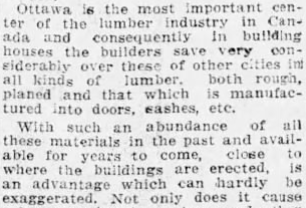
But just what is “plank or frame construction,” the building type of all but two of these worker’s cottages (those being brick). Plank is a type of wood construction that was “the first attempt to improve by simplification upon the traditional methods of building homes that made use of complicated joints.” This was a type of construction that could be built by a laborer untrained in the building arts or sciences, and relied on ready sources of softwood lumber. This building technique was only ever very popular in Scandinavia, Quebec, Ontario, and parts of the United States, where lumber was in easy supply. As such, the construction of these Hintonburg cottages is directly related to Ottawa's then status as a lumber town. Unlike other wood construction methods plank construction used more lumber, which in Ottawa, the mills on the Chaudiere could provide.
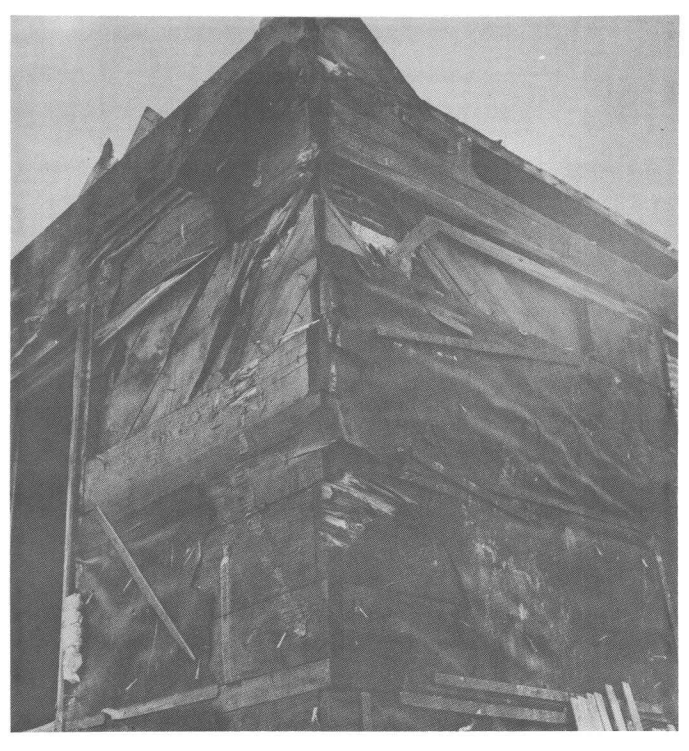
Traditional wood homes involved complex joinery and supports for the beams of the home. Plank construction in the Ottawa area could take one of two forms, both predicated on thick 2-4 inch boards. In the first method, which derived from Quebec’s “grove post” construction technique, boards would be slotted together between the houses four posts and bottom plate, with chinking (a form of caulking) applied between them, and with the individual planks aligned and held by wooden pins. The second, and likely more popular, has been dubbed “plank on edge,” and unlike the previous method, its walls are entirely structural - having no skeleton or frame. Plank on edge or “plankwall framing,” usually “consists of 3-in. planks placed vertically as posts with planks of similar thickness laid horizontally on edge between them, with nailed connections between the vertical and horizontal planks.” At corners, the planks would overlap, and be staggered (for added stability), held together by nails, as seen here:
“Plank construction” or carvel planking, is so named for the carvel, a type of boat from which this woodworking technique is derived. This is different from balloon frame construction, which features continuous “studs” from the foundation to the roof, which is braced by beams and floor joists. That term possibly originates from the French maison en boulin, or log house. Balloon frame was made possible by both mass production of nails (which meant joinery was no longer necessary), and dimensioned lumber in standard sizes. While balloon framing would evolve to allow homebuilding to become disentangled from the historic craftsmanship of carpentry, in the late 19th century it was still a relatively recent innovation. So here in Hintonburg, the early workers who built their homes in Manchesterville relied on plank construction, and its relative ease over other forms of traditional carpentry. It also meant that since the entirety of the home was structural, fires like that of May 26 1896 could be devastating.
As one historian has noted, this plank “method can apparently be traced all the way back to early Viking days in Denmark... where it spread through Europe, becoming firmly established in northern France before it was introduced into Canada.” It's enticing to think of these homes not only in the pattern of rural English worker’s cottages, but in their link to the “Viking's” and vernacular Northern European architecture.
Frame construction, for its part, is similar to “grove post” plank construction in that the boards, which here were sometimes whole log beams, would be slated into the frame of the house, creating walls. The boards or logs were then sealed together with chinking. As architectural historian Barbara Humphreys, who directed research for parks Canada has noted: “in the Rideau area, particularly in the small communities, frame buildings of this style are seen with increasing frequency from the 1860s on.” Whether plank or frame, the building materials for these early homes were hauled from to the build site from the nearby Mason and Son’s Mill or from those on the Chaudiere.
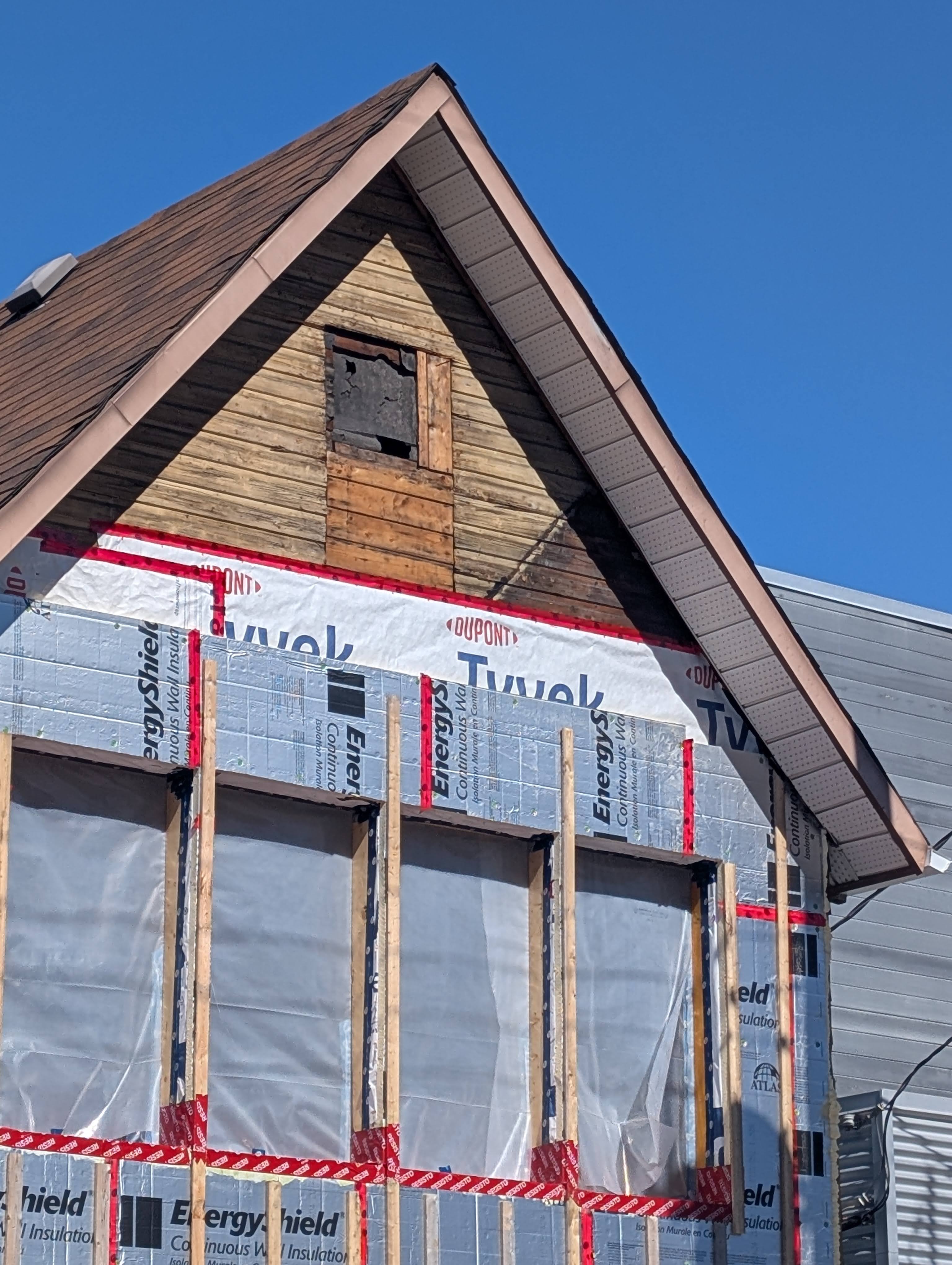
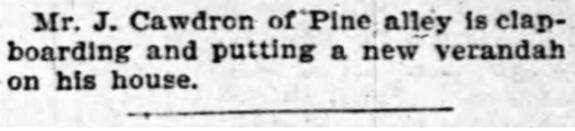
Cheap and cheerful, the unadorned planks of plank on edge or frame construction worked perfectly as a house on its own, though many Hintonburg workers chose to upgrade their homes over time as they could afford. The original plank construction of these homes is often now hidden behind a century's worth of updates - from vinyl sheeting to brick and wood veneer. The two ubiquitous additions to plank homes were clapboard siding on the outside and lath and plaster on the inside. Clapboard siding consists of overlapping boards nailed to the planks, and provided both better weatherproofing, and a greater aesthetic appeal as compared to the rough hewn planks. Such upgrades were often points of pride by their owners, such as J. Cawdrons 1898 addition to his home:
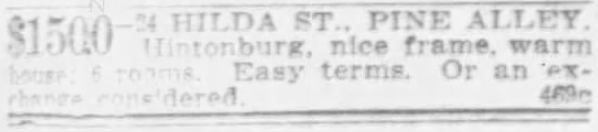
On the interior, lath and plaster was applied, often over a rudimentary insulation of newspapers - pressed flat against the walls to the cover seams between planks and gaps in the chinking. These upgrades were not necessary to the house's structure or general functioning, but its telling that homeowners had a continued pride in the appearance of their house. In fact, proper insulation and clapperboarding were often selling features in the resale of such homes:
In the early 20th century many home owners added a brick or faux stone veneer (known as “formstone”), obsessively to provide additional fireproofing. Despite this, many homes in the area, like those at 88 or 107 Pinhey Street, only feature “formstone” on the front facade of the first floor. We could infer from this that most residents likely didn't have the money to redo their entire exterior in this material, and so added it to the front simply for aesthetic appeal. Many cottages also have additional sections behind the main building, added from the 1920s-30s on, and which are largely built out of balloon frame construction - which by then had become more commonplace.
This page has paths:
This page references:
- A much larger Hintonburg house under renovation shows clappboard siding on top with a remodel into a contemporary balloon frame structure beneath.
- The exposed corner of a plank frame house showing the abutting wood planks
- Home upgrades as reported in the Ottawa Journal
- Home sales as reported in the Ottawa Journal
- "Abundant" lumber as provided by the Chaudiere mills